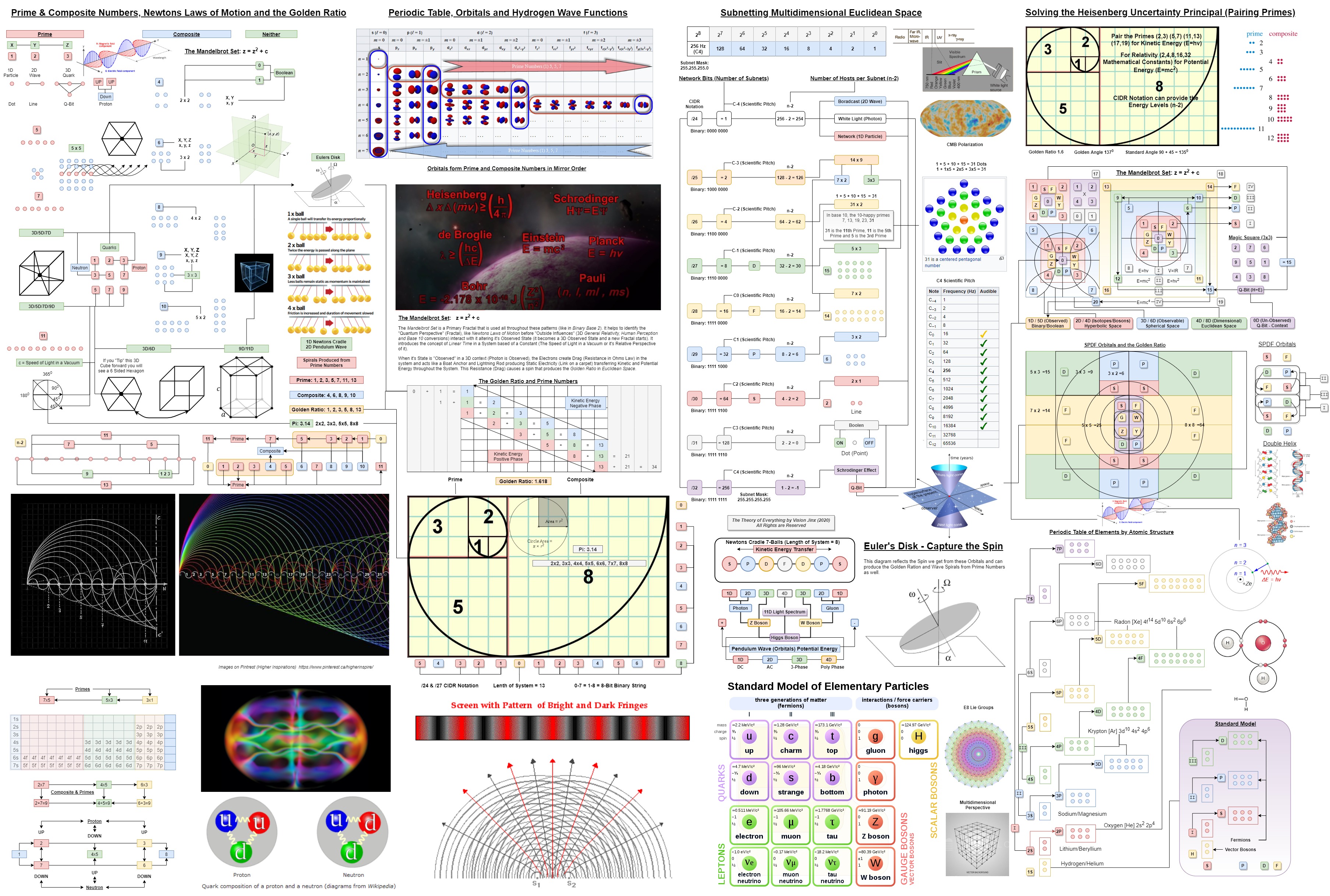
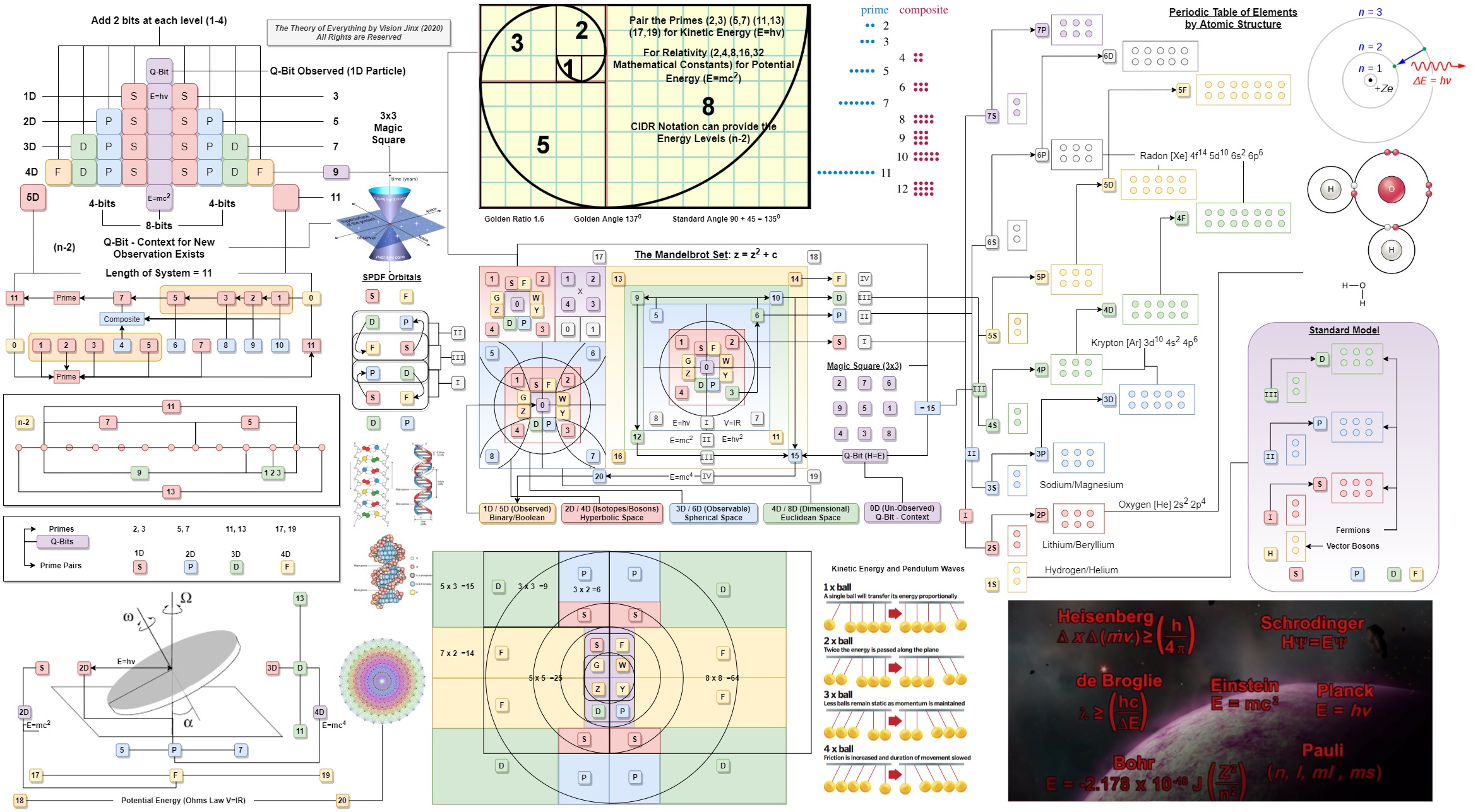
I have tried to make several variations of this and here are some of the images I have made to help explain some of the Quantum Mechanics topics on my demo page. Cheat Sheet 1 and Cheat Sheet 2. Wikipedia has an article on Quantum Field Theory if you want a more technical explanation of this. You can also check out the Standard Model of Elementary Particles for a good starting point.
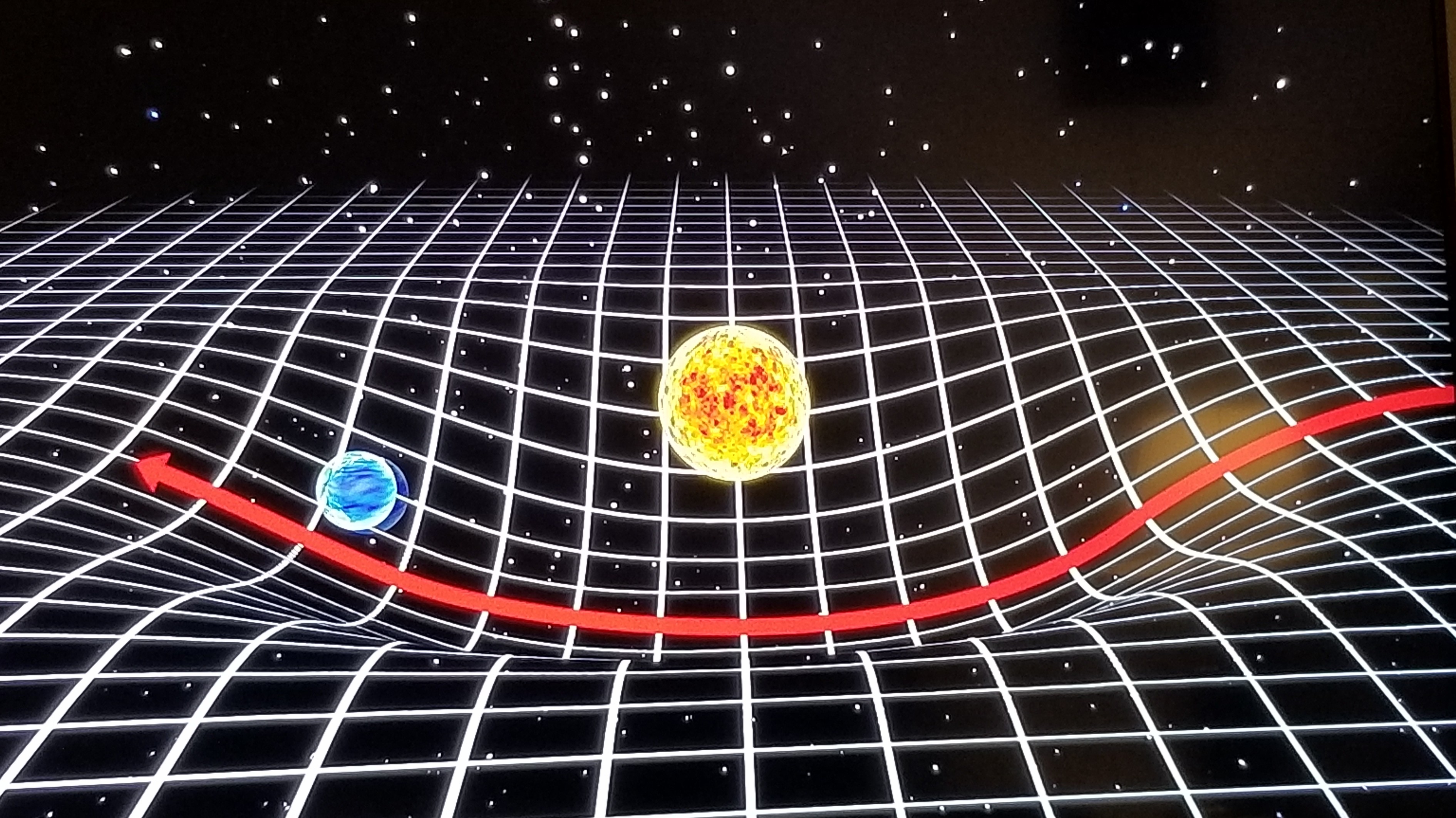
A "Theory of Everything" will bridge Quantum Mechanics with Einstein's theory of General Relativity. General relativity describes gravity not as a force but as the curvature of spacetime caused by mass and energy. Basically, you need to find gravity in Quantum Mechanics for things to come together, so far no such theory has been found. Quantum Mechanics describes the incredibly small (sub-atomic particles) and General Relativity describes the incredibly large like planets and a solar system etc, and to some degree Black Holes.
A lot of the demos on my demo page revolve around my experiments with the Double Slit Experiment which I have done a tonne of experiments around. This describes the duality of a photon having both a wave and particle like duality. Essentially, Photons exhibit both wave-like and particle-like properties, a phenomenon known as wave-particle duality, which is fundamental to quantum mechanics. General relativity, as described by Albert Einstein, predicts the existence of black holes as a result of the curvature of spacetime caused by a sufficiently compact mass. The event horizon is the boundary beyond which nothing can escape, and the central singularity represents the point of infinite curvature. This is the extreme opposite from Quantum Mechanics and sub-atomic particles with a wave-particle duality, Hydrogen Wave functions etc. is a good place to start and where I spend most my time exploring.
Note (fun fact): I am not sure how much sense this will make to you, everyone is different and I do flip between different bases of math quite often, for example I tend to use Base 10 (decimal) for General Relativity, (the very large) and Base 2 (binary) for Quantum Mechanics, (the very small), as well as Base 16 (Hexadecimal or hex) which is used in IPv6 for example, but it does provide a good reference for me to work from. A good example of this is in my Collatz Conjecture demo where I include both Base 10 (decimal) and Base 2 (binary). I do tend to think that the math for physics and quantum mechanics does need to incorporate different bases of math for things to come together. With that being said, as a musician, I have worked as a Studio Musician (I spent 4 years in music college as a theory and composition major for classical music), a Sound Engineer (recording studio), and an Audio Design Engineer (using 70 Volt speaker systems), so I do understand waveforms from this perspective the most.
Tell me more - You can think of a speaker producing a pressure wave to produce sound or a microphone recoding the analogue pressure wave as a waveform in a digital recorder using digital bits, (sampling rate). Analog recorders use magnets (the tape head) to record this as in a tape recorder (audio cassette tape) and a digital audio tape (DAT) recorder uses an analog tape to record digital bits, a combination of both. A spinning disk hard drive works in a similar fashion using platters that stores and retrieves digital data using magnetic storage. A compact disc (CD) produces "pits" on the surface of a CD to represent an ON or OFF state of a binary bit, this is also tied to the sampling rate of a CD (The standard CD sampling rate is 44.1 kHz, meaning audio is sampled 44,100 times per second). Many audiophiles will claim that a record player recoding the analogue waveform on a record produces "better sound" then the sampling rate of a CD, while digital enthusiasts will claim that the human ear can not detect the difference due to the number of samples of the waveform per second a CD produces. MP3 vs FLAC is where some people claim that a MP3 sounds just as good. I mention this stuff because as you approach the Plank Scale (Plank Length and Plank Time) the math becomes quantized as it theoretically can not be broken down any further, similar to a sampling rate at the Plank Scale.