Collatz Conjecture Search
Home New Article Article Search Tag Search Asset Upload Asset SearchSearch
Enter a Positive Integer (a whole number above 1) and using the Collatz Conjecture and Prime Factorization you will be able to see how it creates prime number pairs.
If the number is even, divide it by two.
If the number is odd, triple it and add one.
So for all even numbers, we would have:
n/2
and for all odd numbers, we would have:
n * 3 + 1
The Collatz conjecture is: This process will eventually reach the number 1, regardless of which positive integer is chosen initially.
This is also known as the 4-2-1 Loop where 1 * 3 + 1 = 4 creates an infinite loop.
I have broken out the Prime Factorization so you can see they create a chain of 2 * 2 * 2 then Prime Numbers multiplied by other Prime Numbers like with RSA Encryption and 'Large Prime Number Pairs' (n = p * q). Note: This is not the same as Twin Primes like with 3-4-5 or 11-12-13 or 101-102-103.
I have also broken out this "Waterfall" effect when numbers are divisible by 2 and converted them to a Base 2 prefix. This may not make sense in this context, but when you divide a number by 2, its like Base 2 (binary) in reverse in this context until you reach 2^0 = 1.
A basic example of this would be for the following:
2 * 2 * 2 * 11 = 88
Could be written as 2^3 = 8 (Powers of Two) which is the same as 8 * 11 = 88
As each round is dividing the even numbers by 2, you will see this walk down the base 2 number line until you reach a Prime Number or Primes Multiplied by other Prime Numbers.
In this particular case, we would keep dividing by 2 until we reach 11 which is a Prime Number and can't be broken down any further.
Note: You may also notice this 'Base 2 prefix' pattern of 2^2 - 2^1 - 2^0 is a '4-2-1 loop' as well, resulting in an odd number and the conjecture starts again (n * 3 + 1).
If you have ever worked with CIDR Notation and Subnet Masks, this is why I am grouping them this way, they can act like Subnet Mask bits and Prime^2 -1 = 24 * n (which is a /24 mask and can be found in a 3-4-5 triangle as tangent 3/4 = 0.75).
In the diagram below you could also look at it as 2^3 + 2^4 = 24 = 2^5 - 2^3
Another Example: 2 * 2 * 2 * 2 * 7 * 11 = 1232 or 2^4 = 16 * 7 * 11 = 1232
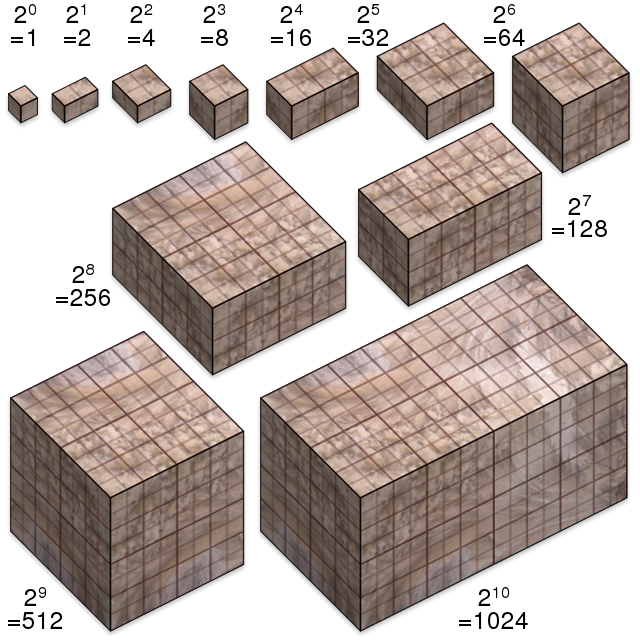
Image from Wikipedia: https://en.wikipedia.org/wiki/Power_of_two
Give 341 and 149 a try for yourself!